Over
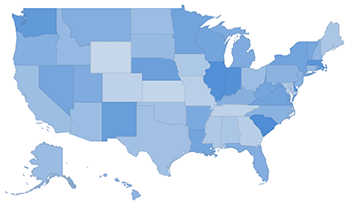
8,023,306
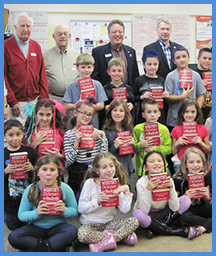
children have received a dictionary thanks to the generosity of sponsors who have participated in the Dictionary Project. Sponsors provide a dictionary for the children in their community each year, so they can enjoy the benefits of a large vocabulary.
2,331,795
dictionaries were given to students in 2007 as a gift from people who live in their town.
is a 501(c) (3) nonprofit organization. The goal of this program is to assist all students in completing the school year as good writers, active readers and creative thinkers by providing students with their own personal dictionary. The dictionaries are a gift to each student to use at school and at home for years to come. The Dictionary Project gives 95 cents of every dollar donated toward the purchase of dictionaries.
Reading is the most important skill of all. It is the starting point for all the economic and social opportunities this world has to offer. Educators see third grade as the dividing line between learning to read and reading to learn. Every year we watch The Dictionary Project grow by expanding our pool of sponsors, so more children can enjoy the benefits of owning their own personal dictionary. |
Our sponsors have made tireless efforts to improve literacy and the quality of life in their communities. These volunteers are the breath of life of The Dictionary Project. Through The Dictionary Project, people feel empowered to affect change and improve education so that the children will grow up better prepared to compete in the global economy.
On October 16, 2008, we will celebrate Noah Webster’s 250th birthday.
Webster’s Compendious Dictionary of the English Language was the
first dictionary that used distinctly American spellings, pronunciations,
and definitions. He helped to reform elementary education in America
and was a major proponent of copyright laws. We can think of no better
way to honor his memory than by making sure that every American third
grader receives his or her own dictionary. It’s Noah’s birthday, but the children of
America get the presents! (By the way, this is also the perfect time to look up the
word “semiquincentennial.”)
- Consider expanding your organization’s project to include an additional school or an additional school district. If there is a neighboring town where no one has started a project, include those children in your distributions.
- Encourage friends, family and colleagues to start or contribute to projects where they live.
- Write letters to the editors of newspapers in towns and cities where no project has yet been started. The Dictionary Project was founded as a response to a letter to the editor that Mary French read in 1995.
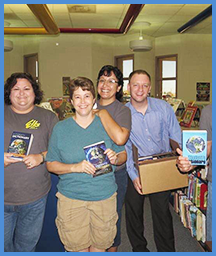
If you have participated in giving out dictionaries to children, you are the best ambassador this program has. The word we most often hear from our sponsors describing their participation is “rewarding.” Most people are surprised and gratified that the time they took to visit the schools to present the dictionaries to the children was worth every minute, and they can’t wait to return next year or to include another school in their project. One man called to tell us how happy he felt after visiting a school. He had been appointed the Dictionary Project chairman for his club, and he thought that the children would respond to the dictionaries with the same excitement that they would have if they received a new pair of socks: They know they need socks and they appreciate the thought, but they don’t get excited. He was shocked that the children applauded him for bringing the dictionaries. He couldn’t leave the room because each student wanted to show him a new word in the dictionary. They even asked him to autograph their books!
Who do you know who would enjoy seeing children excited about learning? Who have you heard lament the state of education today and wish there were something they could do about it? Please tell them about the project. When you do, by all means use our “official” reasons for giving out dictionaries (see the “Why We Do What We Do” section of this newsletter for ideas). But more importantly, tell your own story. Every project is unique, and you can talk most passionately about your own experience. Share the funny and touching thank-you letters you have received. Recall how many children have told you, “This is the first book I have ever owned.” Show photos of beaming children voraciously exploring their new dictionaries.
We have faith that there are enough adults in this country who are committed to helping children become strong readers that we can reach every third grader this year and every year. Please join us in believing and in making that belief a reality.
We also need “super-sponsors” to coordinate and oversee the project in each state. If you are willing to devote more time and energy to the cause of literacy than your individual project requires, please consider joining friends like Larry Hutchinson of Iowa, Wally Brown of Utah, Bob Pityo of New Jersey, Gloria King of Hawaii, George and Mary McIlvaine of Wyoming, and David Boynton of New Hampshire as a state coordinator for the project.
Why We Work in South Carolina
We wanted to understand why The Dictionary Project, which has been well received in most states, was virtually ignored in South Carolina for years. Every third-grade student in South Carolina public schools has received a dictionary for the past eight years, thanks in part to donations from people all over the country and Rotary Clubs in Districts 7770 and 7750. Unfortunately, we have not found local sponsors in much of the state. We believe that these pictures of schools in South Carolina clearly demonstrate that the people responsible for making education policy and funding decisions in this state do not understand the value of education, or grasp that it is an integral part of a prosperous economy.
Corridor of Shame ( http://www.dictionaryproject.org/corridor_of_shame.asp )
Recently the former superintendent of Charleston County schools had this to say about the school district:
http://www.charleston.net/news/2007/jun/14/pointed_words_good_feelings/ (click on link to open)
It wasn't until 1992 that standardized tests were mandated by the state of South Carolina and administered to the students to evaluate the level of education each child received in school. The test scores validated the SAT scores already on record that ranked South Carolina 50th in the nation. SAT scores in South Carolina are rising more quickly than those of the nation as a whole, but are still well below the national average. South Carolina average scores in 2007 were 488 Critical Reading , 496 Mathematics, and 475 Writing; United States average scores in 2007 were 502 Critical Reading , 515 Mathematics, and 494 Writing. (The SAT scores on a 200-800 point scale in each subject area.) The percentage of students meeting state standards in Language Arts on the 2007 Palmetto Achievement Challenge Test (PACT) is over 85% for third graders, but falls for higher grades, to just 71% of eighth graders who meet standards. PACT scores also show significant racial disparities: While 67% of white students score proficient or advanced in Language Arts, only 38% of African-American students attain such scores. High school graduation rates, depending on the methodology used to compute them, show that somewhere between 30 and 50 percent of entering ninth graders will fail to graduate within four years. This rate is among the worst in the nation. Overall graduation rates reported by the South Carolina Department of Education have fallen every year since 2003.
(Statistics are available on the South Carolina Department of Education website, www.ed.sc.gov . Other graduation-rate studies are at http://www.unitedhealthfoundation.com/shr2004/components/hsgrad.html and http://www.manhattan-institute.org/html/cr_baeo_t2.htm .)

If you would like
to start a Dictionary Project Click
Here
To find a list of Dictionary
Projects in your state, choose from the list below:
|